 how-to
How to Book an Accessible Cruise Cabin With Confidence
Last Updated: October 26, 2026
Quick Summary
Accessible cruise cabin booking starts with early action, because every major ship carries only a small number of fully accessible staterooms and they sell out long before general inventory does. Book as soon as your dates are firm, ideally when the sailing first opens, and get the cabin's measurements in writing before you deposit.
- Build a one-page needs profile covering equipment dimensions, transfer style, and bathroom routine before comparing cabins.
- Ask for the clear opening width in inches and leave a margin of at least an inch or two.
- Ambulatory accessible cabins may have grab bars and a shower bench but no roll-in shower.
- Submit the special assistance form as soon as the cabin is deposited, then confirm receipt a few days later.
- Never accept a guaranteed cabin without written confirmation that it is accessible.
Table of Contents
- Why Accessible Cruise Cabin Booking Rewards Early Action
- Accessible Stateroom Features That Decide Whether a Cabin Works for You
- How to Book an Accessible Stateroom Step by Step
- Cruise Cabin Availability: What the Numbers Mean for Your Booking
- Questions to Ask When Booking an Accessible Cruise
- Mobility Equipment, Medical Devices, and Special Assistance Requests
- When Accessible Cabins Are Unavailable or Your Needs Change
- Start Your Accessible Cruise Cabin Booking With Gangway Vacations
- Frequently Asked Questions
Why Accessible Cruise Cabin Booking Rewards Early Action
Accessible cruise cabin booking starts with one hard truth: these rooms are few.
A ship might hold thousands of passengers but only a handful of cabins with a roll-in shower and a wide doorway, and demand easily outruns supply.
So the first rule of accessible cruise cabin planning is timing. Book as soon as your dates are firm, ideally when the sailing first opens.
- Accessible staterooms are a small share of any ship's inventory
- Popular routes and school-break dates go first
- Early booking gives you the widest choice of cabin type and location
Accessible Stateroom Features That Decide Whether a Cabin Works for You
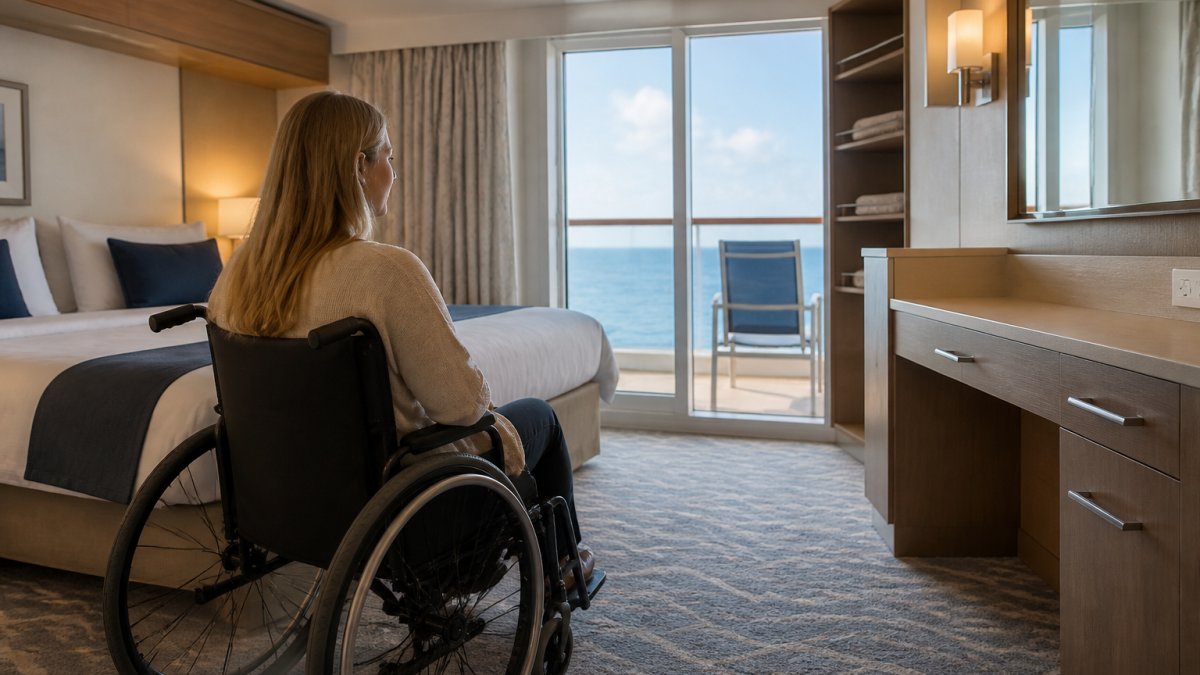
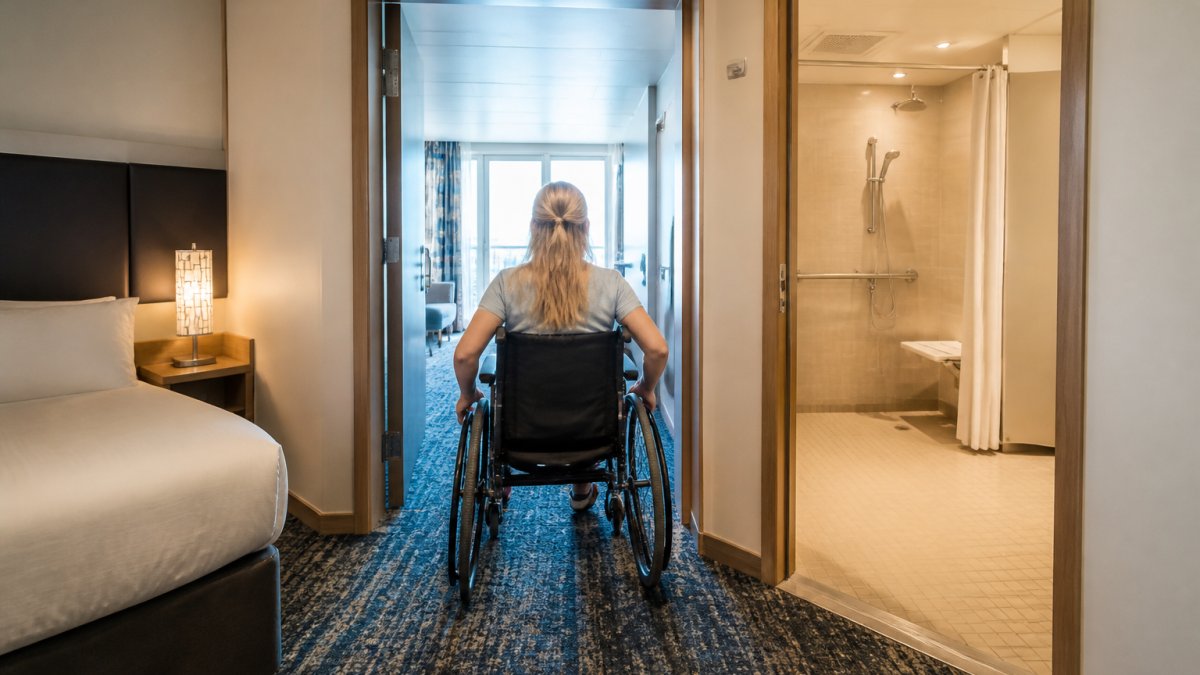
An accessible stateroom is a cabin designed for wheelchair users and people with mobility disabilities, with a wider doorway, open floor space, and a bathroom built for seated use.
Build a Needs Profile Before You Compare Cabins
Most booking mistakes happen because the traveler compares cabins before writing down what the cabin has to do. Build a one-page needs profile first, then use it as a filter. It should cover:
- Mobility equipment dimensions. The widest point of your wheelchair or scooter (including armrests and footrests), its overall length, its turning circle, and its weight.
- Transfer style. Whether you transfer independently, with a sliding board, with a lift, or with a companion's help, and which side of the bed you transfer from.
- Bathroom routine. Whether you need a roll-in shower, a shower bench, a raised toilet seat, a roll-under sink, or a handheld sprayer.
Keep the profile with your booking file to read from when the accessibility desk asks what you need.
Doorway Width, Floor Space, and Turning Radius
Doorway width is the first number to confirm. A standard cabin door is too narrow for most wheelchairs and scooters.
Floor space and turning radius matter just as much: you need room to turn the chair and move between the bed, bathroom, and balcony door.
Also ask about the balcony door threshold. Many accessible cabins have a small lip there.
Bathroom Layout: Roll-In Showers, Benches, and Grab Bars
The bathroom is where most accessibility promises succeed or fail. Look for:
- A roll-in shower with no lip or step, and confirm the shower floor slope and drain placement so water does not pool at the entry.
- A fold-down shower bench rated for your weight, and whether it is positioned for a seated transfer or a standing transfer.
- Grab bars at the toilet and in the shower, and whether they are placed for your reach and transfer direction.
Some cabins are ambulatory accessible, suiting a guest who can walk short distances but cannot manage steps. These rooms may have grab bars and a shower bench but no roll-in shower. If you use a wheelchair full time, an ambulatory cabin will not work. Say so clearly when you book and ask the line to note it on the reservation so a later reassignment does not move you into one.
Match the Cabin Type to the Equipment, Not the Other Way Around
Once you have the numbers, the matching step is mechanical:
- If your wheelchair's widest point is within an inch or two of the stated clear opening, treat that cabin as a fallback, not a first choice.
- If you need a roll-in shower, exclude every ambulatory-accessible cabin from your list before you compare price or location.
- If you transfer from the bed with a board or lift, confirm transfer space on the side you use and ask whether the nightstand can be moved.
What the Label Does Not Tell You
Two cabins with the same accessibility label can differ in door width, bathroom configuration, bed height, and balcony threshold. The only reliable comparison is the written measurement for the specific cabin number. If a line will not provide measurements before deposit, treat that as a warning sign.
How to Book an Accessible Stateroom Step by Step
Booking an accessible stateroom follows a clear sequence: pick your sailing, confirm the cabin's measurements, reserve it, and submit the cruise line's accessibility form. Skip a step and you risk losing the room or arriving to a cabin that does not fit your equipment.
- Set your dates and route first. Flexibility on sail date widens your cabin options.
- Ask for the accessible inventory. Request the specific cabin numbers and categories, not just "an accessible room."
- Get the measurements in writing. Doorway width, bathroom type, bed height, and turning space.
- Match the cabin to your equipment. Compare doorway width to your wheelchair or scooter.
- Reserve with a deposit. Accessible cabins are held like any other, so a deposit locks it in.
- Submit the disability form. Most lines require a special assistance request or mobility questionnaire.
- Confirm the cabin number. Get it in writing before final payment.
- Reconfirm closer to sailing. Ask again about the cabin and any equipment you are bringing.
If you would rather hand the cabin selection to someone who does this daily, book your cruise through a one-on-one appointment with our travel advisor.
| Step | What You Do | Why It Matters |
|---|---|---|
| 1 | Set dates and route | More dates mean more cabin options |
| 2 | Request accessible inventory | You see the real list, not a guess |
| 3 | Get measurements in writing | Confirms the cabin fits your chair |
| 4 | Match cabin to equipment | Prevents a painful mismatch |
| 5 | Reserve with deposit | Locks the limited cabin |
| 6 | Submit disability form | Triggers special assistance |
| 7 | Confirm cabin number | Avoids a surprise reassignment |
| 8 | Reconfirm before sailing | Catches any last-minute change |
Cruise Cabin Availability: What the Numbers Mean for Your Booking
Cruise cabin availability for accessible rooms is tighter than most first-time cruisers expect. Each ship holds a limited number of these cabins spread across categories, so a sailing can show open rooms overall while every accessible stateroom is gone.
Watch for a few signals:
- "Guaranteed cabin" offers mean you get a room in a category but no choice of number. For accessible needs, avoid this unless the line confirms the room is accessible.
- Waitlist is worth joining, but treat it as a backup, not a plan.
- Newer and larger ships tend to carry more accessible cabins, so widen your ship search.
The cruise industry accessibility guidance from cruise line trade groups stresses confirming cabin details directly with the line, because layouts differ ship to ship. Do not assume two cabins with the same label are identical.
Questions to Ask When Booking an Accessible Cruise
The right questions protect your trip. Ask them before you pay, and get answers in writing where you can.
- What is the exact doorway width, and does it clear my wheelchair or scooter?
- Does the bathroom have a roll-in shower, or is it ambulatory accessible only?
- Is there transfer space on both sides of the bed?
That last question matters. A cabin can look right on paper and still have a problem on day one. Knowing the onboard accessibility contact saves hours.
If you want a cruise expert to answer these before you commit, get in touch with our team and we will walk through them with you line by line.
Mobility Equipment, Medical Devices, and Special Assistance Requests
Mobility equipment needs planning beyond the cabin. Cruise lines generally require advance notice for wheelchairs, scooters, oxygen, and other medical devices, and some have rules about battery types, storage, and charging. Smooth boarding usually comes down to whether the request was submitted early and confirmed in writing.
Submit the Special Assistance Request Early and Confirm Receipt
Most lines use a special assistance form, a mobility questionnaire, or an accessibility request section inside the booking, with deadlines often weeks before sailing. A practical sequence:
- Submit the form as soon as the cabin is deposited, not after final payment.
- Save the confirmation number or email acknowledgment.
- Call the accessibility desk a few days later and ask them to read back what is on file.
- Reconfirm again about two weeks before sailing, and ask whether the request is attached to the specific cabin number.
A common pattern is a request submitted but never linked to the reservation, so the ship has no record when you arrive. Confirming receipt, not just submission, catches this.
Scooter and Wheelchair Rules: Size, Storage, and Charging
Rules vary by line, but the practical questions are consistent:
- Size limits. Some lines limit scooter dimensions or require that the scooter fit through the cabin door and be stored inside the cabin, not in the hallway. Hallway storage is usually prohibited for safety and evacuation reasons.
- Charging. Confirm where you can charge the scooter or wheelchair batteries. Many lines allow charging in the cabin but prohibit charging in corridors or public areas. Ask whether the cabin has enough outlets near the parking spot, and bring a compatible extension cord or power strip if the line permits it.
- Battery type. Lithium-ion and sealed lead-acid batteries are handled differently. Ask the line's policy for your specific battery type, and carry the battery documentation with your travel papers.
Oxygen, CPAP, and Other Medical Devices
For oxygen concentrators, CPAP machines, and similar devices, ask:
- Whether the device can be used in the cabin and whether the line requires a medical form or physician's letter.
- Whether the ship can supply distilled water for CPAP use, or whether you must bring your own.
- Whether the device needs to be declared for airline travel as well, since airline rules differ from cruise line rules.
Plan the Airport, Transfer, and Pier Logistics
Equipment planning does not stop at the ship. If you fly in, arrange accessible transport ahead of time and confirm the vehicle can accommodate your wheelchair or scooter.
The ADA accessibility standards give a useful baseline for what "accessible" should mean for doorways and bathrooms, but cruise ships follow their own standards and international rules. Use the ADA figures as a reference point, then confirm the ship's actual measurements and equipment policies in writing.
When Accessible Cabins Are Unavailable or Your Needs Change
Sometimes the cabin you need is gone, or your needs shift between booking and sailing. You still have options.
- Widen your dates or ships. A different week or a larger ship can free up an accessible cabin.
- Join the waitlist and keep checking. Cancellations happen.
- Ask about ambulatory cabins if your needs have changed and you no longer require a roll-in shower.
This is where a travel advisor earns their keep. Learn how a travel advisor can help when availability is tight or your needs change.
Watch out: never accept a guaranteed cabin without written confirmation that it is accessible. A reassignment at the pier is the last place you want to discover the doorway does not fit.
Start Your Accessible Cruise Cabin Booking With Gangway Vacations
Getting the cabin right takes early action, exact measurements, and the right forms filed on time, exactly what we handle at Gangway Vacations.
Our service is free, with no booking fees. A licensed travel advisor coordinates flights and hotels, and submits the special assistance paperwork so nothing slips.
Do not leave a limited cabin to chance. Explore and book your cruise with Gangway Vacations.
Frequently Asked Questions
Are accessible cruise cabins available on every ship?
No. Accessible staterooms vary by ship and cruise line, and older vessels often have fewer of them. Some ships offer only a handful of fully accessible cabins with roll-in showers, while others have none at all. Before you book an accessible cruise cabin, confirm the specific ship has the features you need, such as a wide doorway, roll-in shower, and enough turning radius for your wheelchair or scooter. If a particular ship does not work, ask about sister ships or newer vessels in the same fleet.
Can I request an accessible cabin after I have already booked?
You can request one, but you are not guaranteed to get it. Accessible staterooms are limited and often sell out months ahead, so switching later depends on cruise cabin availability at that moment. Call the cruise line or your travel advisor as soon as your needs change and submit the disability form so the request is on record. If no accessible cabin opens up, ask about ambulatory accessible options or a standard cabin near an elevator, and keep checking as final payment dates approach and cancellations occur.
How do I confirm that an accessible cruise cabin will fit my mobility equipment?
Ask the cruise line for the specific measurements of the cabin you are considering, including doorway width, bathroom door width, and floor space. Compare those numbers to the width and turning radius of your wheelchair or scooter, and leave a little extra room for maneuvering. If you use a power chair or large scooter, mention the weight and dimensions when you submit your mobility questionnaire. A travel advisor who books accessible cabins regularly can check these details with the cruise line before you pay a deposit.
What should I ask a cruise line before booking an accessible cabin?
Ask whether the cabin has a roll-in shower or a shower bench, how wide the doorway is, and whether the bathroom door opens inward or outward. Confirm what type of accessible cabin it is, since ambulatory accessible cabins work for some travelers but not full-time wheelchair users. Also ask about tender ports on the itinerary, shore excursion accessibility, and where mobility equipment is stored during the cruise. Getting answers to these questions before you reserve helps you avoid a cabin that does not match your disability needs.
The hardest part of accessible cruise planning is not choosing a destination. It is securing a cabin that truly fits your needs before someone else does. Gangway Vacations takes that weight off your plate with personalized guidance from a licensed advisor, full-service planning for flights and hotels, and expert knowledge across all major cruise lines, all at no cost to you. Get started with Gangway Vacations and sail with a stateroom built for you.